Quick answer: Orbit diameter is how far the sanding pad swings off-center on each rotation. A 9.5 mm orbit removes material fastest and suits rough stock removal and filler shaping. A 5 mm orbit is the all-round choice for most auto body and panel work. A 2.5 mm orbit leaves the finest scratch pattern and is best for final sanding before primer, paint or polishing.
What does "orbit size" mean on an air sander?
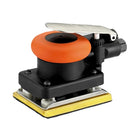
A random orbital sander moves the pad in two ways at once: it spins, and it oscillates in a small eccentric circle. The orbit (or stroke) size is the diameter of that circle. A larger orbit means each abrasive grain travels farther per cycle, so it cuts more aggressively but leaves deeper scratches. A smaller orbit means a shorter path per cycle, so it cuts more slowly but leaves a finer, more uniform finish.
2.5 mm vs 5 mm vs 9.5 mm: comparison
| Orbit | Cutting speed | Finish | Typical jobs | Usual grits |
|---|---|---|---|---|
| 2.5 mm | Slowest | Finest, minimal swirl | Final sanding before paint, clear-coat defect removal, fine wood finishing | P400–P3000 |
| 5 mm | Medium | Smooth, general purpose | Feather-edging, primer sanding, general panel prep | P180–P500 |
| 9.5 mm | Fastest | Coarse | Filler shaping, paint stripping, rough stock removal | P40–P180 |
Which orbit size should I choose for auto body repair?
Most body shops keep more than one sander. A 5 mm tool covers the widest range of jobs. Add a 9.5 mm sander if you do a lot of filler work, and a 2.5 mm sander if you sand clear coat or prepare panels for show-quality paint. If you can only buy one, choose 5 mm.
Does pad size matter too?
Yes. A 6" pad covers large flat panels quickly. A 5" pad is easier to control on curved surfaces. A 3" pad reaches spot repairs and tight contours. Choose the pad size for the shape of the workpiece, then choose the orbit for the finish you need.
Non-vacuum, self-vacuum or central vacuum?
- Non-vacuum: the lightest and simplest option, for shops with separate dust extraction or for wet sanding.
- Self-vacuum: sends dust into an attached bag, so no external extractor is needed.
- Central vacuum: connects to a shop dust-extraction system and gives the cleanest workspace and longest abrasive life.
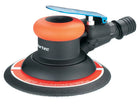
Soartec air random orbital sanders by orbit
- 2.5 mm: 5" Air Random Orbital Sander 2.5mm Orbit Non Vacuum | WS-105NF-5H
- 5 mm: 6" Air Random Orbital Sander 5mm Orbit Non Vacuum | WS-105N-6H (12,000 rpm, 0.89 kg)
- 9.5 mm: 5" Air Random Orbital Sander 9.5mm Orbit Central Vacuum | WS-105CR-5H
- Self-vacuum: 6" Air Random Orbital Sander 2.5mm Orbit Self Vacuum | WS-1051SF-6H
Browse the full range of 3", 5" and 6" models in Air Random Orbital Sanders.
FAQ
Is a bigger orbit always better?
No. A bigger orbit cuts faster but leaves deeper scratches that the next grit has to remove.
Can I use fine grits on a 9.5 mm sander?
You can, but a 2.5 mm or 5 mm sander gives a more even finish with fine grits.
What air pressure do air random orbital sanders need?
Most industrial models are rated at 90 psi (6.2 bar) at the tool. The Soartec WS-105N-6H, for example, is rated at 90 psi.
Need help choosing? Contact Soartec for specifications, OEM options and distributor pricing.